From scaffolding roots to multi-trade partner
Breck Construction’s story starts small and close to home. In 2002, a Saskatchewan scaffolder named Royan Stewart started out with just one client and three team members, calling his business Breck Construction. Built through reputation and word of mouth, this small outfit grew rapidly and eventually peaked at roughly 250 to 300 staff during the 2010 to 2011 construction boom. “We gained a reputation for doing great work, having great people, and being a place people wanted to work,” Chief Executive Officer Bobbylynn Stewart says.
When the market cooled, Breck adapted. Clients still needed trusted partners, but they wanted fewer interfaces and tighter coordination. Breck broadened from scaffolding to a full multi-trade model, adding insulation, sheet metal, mechanical, civil concrete, and general contracting to their list of services. This meant clients could work with one accountable team, one schedule, and one safety culture.
You can see their approach in action at a long-running Saskatchewan potash site, where Breck provides services under a single general superintendent. The client knows the faces and the standards, and changes can be made in hours rather than days.
Safety and quality are at the heart of everything Breck does. In this regard, it has obtained the nationally recognized Certificate of Recognition aimed at helping companies build safer workplaces. “We want to make sure that we are doing the work safely, and everyone comes home safe every night,” Director of Corporate Services Deanne Schwartz says.
Breck Construction exemplifies Saskatchewan’s entrepreneurial drive, offering multi-trade industrial services backed by a reputation for reliability, safety, and long-term partnerships. Teams debrief before, during, and after work. They’re also quick to pick up the phone when scopes shift. “When you have a partnership, you feel very confident to go to your partner and have those frank discussions about what we can do to make it better,” Stewart says. That communication keeps projects predictable and relationships strong.
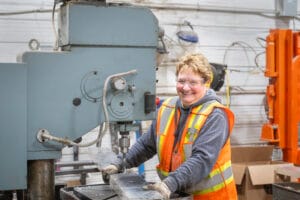
Growth, for Breck, also means widening the door. The company is dedicated to increasing Indigenous participation in its workforce, and continues to build pathways for women in construction, from site roles to leadership. “We have around 25 per cent Indigenous workers, and we are always trying to do more,” says Stewart, who also points to partnerships with community groups and union allies to increase representation and create welcoming environments.
On women in construction, she is direct: “We want an environment where women feel there is a place for them here.” The goal is simple. Breck Construction wants to reach the tipping point where women want and look forward to working in the construction industry, which often comes down to exposure and visible role models.
The plan from here is focused and near term. Breck will deepen its integrated services with Saskatchewan clients, while expanding its Ontario office from a scaffolding base to the same multi-trade model that works at home. Looking further out, the team is preparing for opportunities in the nuclear sector, building the skills and partnerships now to support complex work safely when demand arrives.
Place matters in this story. Schwartz describes Saskatchewan as collaborative and close-knit, a place where competitors still help each other and where you see the same people at sites, rinks and school events. That familiarity and respect shorten the distance between problem and solution, which is exactly what owners want in a partner.
In the end, Breck’s evolution is about staying relevant to clients without losing the heart of the company. The result for Saskatchewan is a stronger, more inclusive industrial services sector, more of the work delivered by people who live here, and a company that proves collaboration is a competitive advantage. It feels like home because it is.
For more information, contact:
Media Relations
Regina
Phone: 306-526-6302
Email: media.ted@gov.sk.ca